 RMON
- How to set up your Time zone
- How to create a Telegram bot and use it with RMON
- How to create a Slack APP and use it with RMON
- How to create PagerDuty Integration key and use it with RMON
- Notifications and alerting
- Status pages
- Security checklist
- Company sign-in with OIDC
- Get started with the RMON API
- Backup and recovery
- How to use groups and roles
- How to change user settings
Servers
SSH credentials management
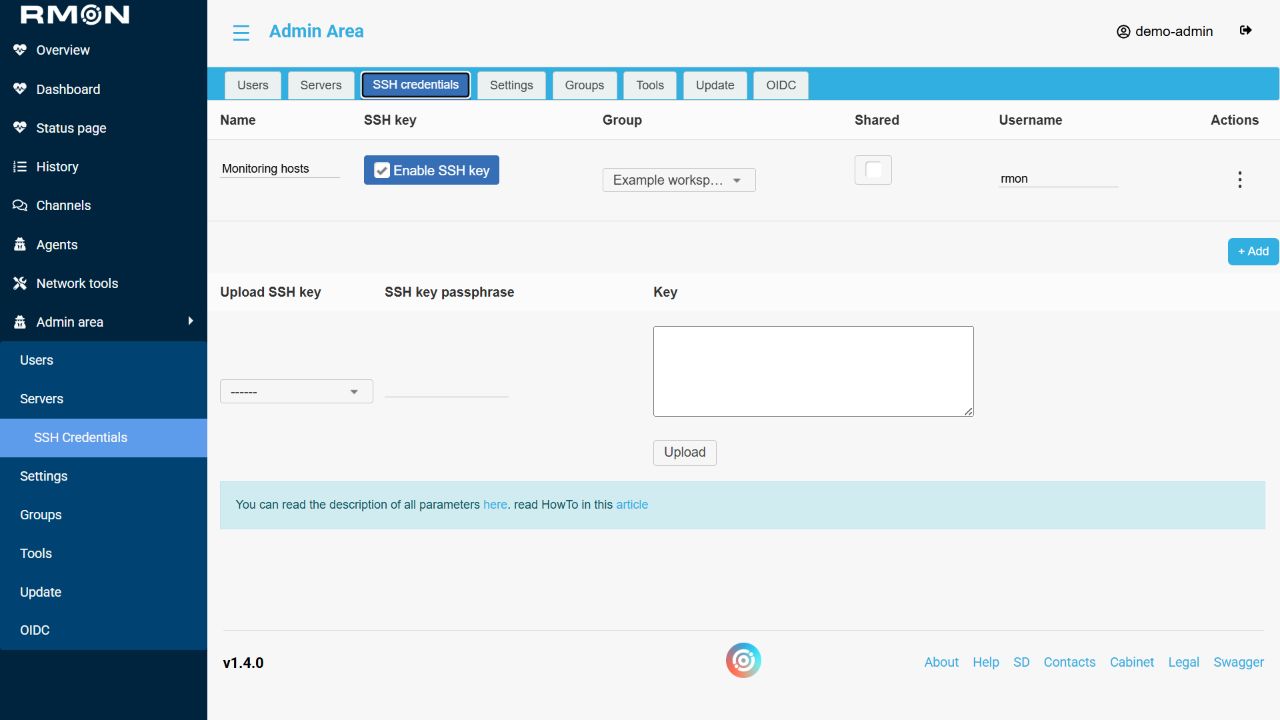
An SSH credential is the host account RMON uses to install and manage agents. Save it under Admin area → SSH credentials, then select it on one or more server records. RMON does not create the operating-system account on the host.
Choose the credential fields
Scroll horizontally to view the full table.
| Field | Example | How to choose it |
|---|---|---|
| Name | Production monitoring hosts | An alias you can recognize in the server's Credentials selector. |
| Username | rmon | The SSH account already present on each target host. |
| SSH key | Enabled | Enable to authenticate with an uploaded private key; disable to enter the SSH account password. |
| Group | Production | The credential's owner. The selector depends on your role. |
| Shared | Disabled | Enable only when other groups should be able to use this credential. Ownership remains with the original group. |
Save and upload a private key
- Click + Add, fill in the fields above and save the credential.
- In the Upload SSH key section, select that credential from the list.
- Paste the entire private key into Key, including its opening and closing lines and line breaks.
- If the key is encrypted, enter its SSH key passphrase. Otherwise leave the passphrase blank.
- Click Upload. Assign the credential to the server and run Check SSH.
The matching public key must already be authorized on the host. A public key cannot replace the private key in the upload field. The key passphrase unlocks the private key; the account password is used for password authentication.
Use password authentication
Disable SSH key and enter the host account password in the field that appears. Save the credential and test it on the server. The account still needs non-interactive sudo privileges for installation; the SSH password field is not a separate sudo-password prompt.
Replace a key or password
- Identify every server that uses the credential. A change affects future SSH operations on all of them.
- For a key change, authorize the new public key on those hosts first, keeping the old working key until validation is complete.
- Upload the new private key and its passphrase to the existing credential, or create a separate credential and move hosts individually.
- Run Check SSH on each affected host. Remove obsolete host access only after the replacement is confirmed.
Changing the credential does not reinstall an agent or alter its monitoring targets. Keep the database and application keys together in backups so saved credentials remain usable after restoration.
If the credential cannot be used
If it is missing from the server selector, check the active group, owner group and sharing. If SSH authentication fails, check the host username, authorized public key and passphrase. If login succeeds but installation fails with a sudo error, correct the host account's privileges. Use the SSH troubleshooting table to distinguish these cases.